

CATEGORY: Journal Article

SOURCE: European Heart Journal Open, April 30th 2026, https://doi.org/10.1093/ehjopen/oeag072


Domenico D’Amario1, Donato Antonio Paglianiti2, Renzo Laborante3, Stefano Elia4, Gaetano Rizzo5, Simona Giubilato6, Maria Catalano7, Francesco Amico8, Maurizio Volterrani9, Attilio Restivo10, Stefano Patarnello11, Sofoklis Kyriazakos12, Alice Luraschi13, Agni Delvinioti14, Federica Tomassini15, Konstantina Kostopoulou16, Antonio Iaconelli17, Enrico Incaminato18, Francesco Canonico19, Marco Gorini20, Stefania Marcoli21, Vincenzo artoli22, Thomas Griffiths23, Peter Fenici24, Alfredo Cesario25, Giuseppe Patti26, Filippo Crea27


 1Department of Translational Medicine, University of Eastern Piedmont, Novara, Italy; Thoraco-Cardio-Vascular Department, Azienda Ospedaliero-Universitaria Maggiore della Carità, Novara, Italy

2Department of Translational Medicine, University of Eastern Piedmont, Novara, Italy; Thoraco-Cardio-Vascular Department, Azienda Ospedaliero-Universitaria Maggiore della Carità, Novara, Italy

 3Department of Clinical Science and Education, Södersjukhuset; Karolinska Institutet, Stockholm, Sweden

 4Department of Translational Medicine, University of Eastern Piedmont, Novara, Italy; Thoraco-Cardio-Vascular Department, Azienda Ospedaliero-Universitaria Maggiore della Carità, Novara, Italy

 5Department of Translational Medicine, University of Eastern Piedmont, Novara, Italy; Thoraco-Cardio-Vascular Department, Azienda Ospedaliero-Universitaria Maggiore della Carità, Novara, Italy

 6Department of Cardiology, Cannizzaro Hospital, Catania, Italy

 7Department of Cardiology, Cannizzaro Hospital, Catania, Italy

8Department of Cardiology, Cannizzaro Hospital, Catania, Italy9Department of Cardiopulmonary, IRCCS San Raffaele Roma, Rome, Italy; San Raffaele Open University, Rome, Italy

9Department of Cardiopulmonary, IRCCS San Raffaele Roma, Rome, Italy; San Raffaele Open University, Rome, Italy

 10Catholic University of the Sacred Heart, Rome, Italy; Cardiology Unit, Cardio-Neuro-Vascular Department, Ca’ Foncello Hospital and San Giacomo Hospital, Treviso and Castelfranco Veneto, Italy

11Fondazione Universitaria Policlinico A. Gemelli IRCCS, Rome, Italy

12Innovation Sprint Srl, Brussels, Belgium

13Fondazione Universitaria Policlinico A. Gemelli IRCCS, Rome, Italy

14Fondazione Universitaria Policlinico A. Gemelli IRCCS, Rome, Italy

15Fondazione Universitaria Policlinico A. Gemelli IRCCS, Rome, Italy

16Innovation Sprint Srl, Brussels, Belgium

17Fondazione Universitaria Policlinico A. Gemelli IRCCS, Rome, Italy; Catholic University of the Sacred Heart, Rome, Italy

18Department of Translational Medicine, University of Eastern Piedmont, Novara, Italy; Thoraco-Cardio-Vascular Department, Azienda Ospedaliero-Universitaria Maggiore della Carità, Novara, Italy

19Thoraco-Cardio-Vascular Department, Azienda Ospedaliero-Universitaria Maggiore della Carità, Novara, Italy

20Healthcare Innovation, AstraZeneca, Milan, Italy21Healthcare Innovation, AstraZeneca, Milan, Italy

22Healthcare Innovation, AstraZeneca, Milan, Italy

23Healthcare Service Design, AstraZeneca, London, UK

24Catholic University of the Sacred Heart, Rome, Italy; Healthcare Innovation, AstraZeneca, Milan, Italy; Biomagnetism and Clinical Physiology International Center (BACPIC), Rome, Italy

25Fondazione Universitaria Policlinico A. Gemelli IRCCS, Rome, Italy; Catholic University of the Sacred Heart, Rome, Italy; Scientific Directorate, Fondazione Policlinico Universitario A. Gemelli IRCCS, Rome, Italy; Gemelli Digital Medicine and Health, Rome, Italy

26Department of Translational Medicine, University of Eastern Piedmont, Novara, Italy; Thoraco-Cardio-Vascular Department, Azienda Ospedaliero-Universitaria Maggiore della Carità, Novara, Italy

27Catholic University of the Sacred Heart, Rome, Italy; Center of Excellence of Cardiovascular Sciences, Ospedale Isola Tiberina–Gemelli Isola, Rome, Italy


Abstract

Aims

The “FondAZione A. Gemelli IRCCS Artificial Intelligence Empowered Digital PlatforM to sUpport paTients with Heart Failure” (AZIMUTH) study is a multicenter prospective outpatient trial assessing an app-based, e-health-integrated model of care for heart failure (HF) patients. Its primary aim is to evaluate the feasibility and patient/provider acceptance of the app-based intervention, while key secondary aims include assessing its clinical impact through changes in guideline-directed medical therapy (GDMT) prescription/adherence and quality of life.


Methods and Results

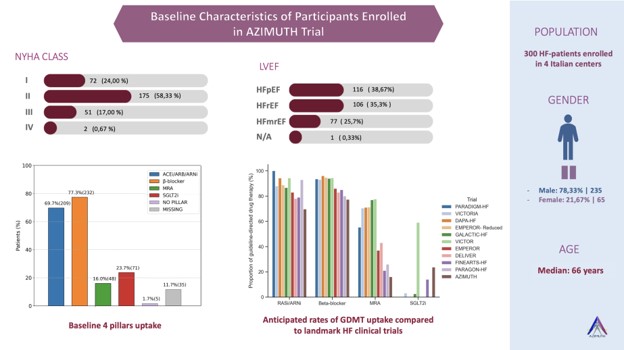
Feasibility is defined as ≥70% of participants maintaining active engagement with the app during follow-up. The platform integrates patient-reported symptoms, connected measurements, medication reminders, and two-way messaging, with clinician review of alerts and trends. Between December 2021 and January 2024, 300 adults with chronic HF, irrespective of left ventricular ejection fraction (LVEF), were enrolled across four Italian centers. Median age was 66 years (IQR 59–73), 78.3% were male, and 82.3% were NYHA class I–II. LVEF distribution was balanced (HFrEF 35.3%, HFmrEF 25.7%, HFpEF 38.7%). Comorbidities were frequent: hypertension 81.3%, dyslipidemia 75.7%, ischemic heart disease 41.0%, diabetes 29.7%, atrial fibrillation 29.7%, and chronic kidney disease 21.7%. At enrollment, RASi/ARNI were prescribed in 69.6%, beta-blockers in 76.9%, MRAs in 16.1%, and SGLT2i in 23.7%. Compared with HFrEF-focused trials, uptake of foundational classes was lower, consistent with the broader LVEF spectrum and real-world constraints.


Conclusion

The AZIMUTH cohort represents a contemporary, heterogeneous HF population with variable and suboptimal GDMT uptake. Digital health interventions have the potential to optimize care delivery and increase adherence in real-world settings


More Publications

Your Privacy

This website uses Cookies to optimize the website use, as well as to adapt to the users’ interests and needs. By browsing the website, the user accepts the use of cookies according to this policy, which is an expansion of the banner for the use of cookies, which appears when a user visits for first time the company’s website home page. Cookies are small text files stored on the user’s computer or other devices (smartphones/tablets) when browsing the website, so that the latter be able to retrieve that information and provide the user with more efficient navigation features.

More Information